

A CASE STUDY CONDUCTED BY:
TOYOKAZU TAKEUCHI, PhD., CPO
KEIZO YAMAMOTO, PhD
The Clinical Challenge
The liner is a fundamental clinical component in prosthetic fitting. It directly influences walking quality and serves as the critical interface between the residual limb and the prosthetic socket.
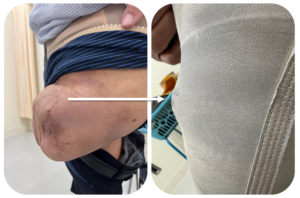
A recent clinical case involving a transfemoral amputee with a short residual limb and a distal bony prominence showed particularly interesting results.
The patient experienced significant pain during walking due to repeated contact between the bony prominence and the inner wall of the socket.
From Patient Feedback to Objective Measurement
From the initial trials, the patient reported a significant reduction in pain when using ALPS gel liners.
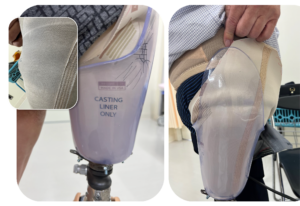
This clinical perception was later confirmed through instrumental evaluation using pressure sensors during gait.
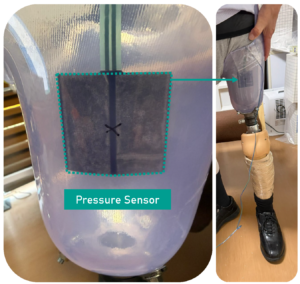
The comparison among different liners showed that OptiGel produced the lowest pressure values during walking.
One of the most notable findings was that OptiGel, while maintaining a firm and stable feel similar to a silicone liner, demonstrated superior pressure distribution during gait. This finding suggests that tactile perception alone does not necessarily reflect clinical performance in the management of dynamic pressure.
The comparison with EasyGel further supports this concept. Although EasyGel feels more deformable when assessed by hand, OptiGel demonstrated a greater ability to distribute pressure during walking.
The Clinical Takeaway
The results highlight the importance of evaluating liner performance not only through tactile perception, but also under the dynamic conditions experienced during walking.
OptiGel addresses the traditional compromise between stability and comfort by combining the control provided by a firm and stable structure with excellent pressure distribution capability.
👉 DISCOVER OPTIGEL